
Stuck on Guess 4? Here's How to Actually Get Unstuck
A real Wordle, a real dead end, and what happens when you hand the board to a tool built to read it precisely — including the part where the tool's best guess is still wrong.
Every Wordle player knows this moment. You're three guesses in, you've got a couple of letters pinned down, and you stare at the board without a single word coming to mind. Not "I can't decide between two good options" — "I have nothing." That's the guess-4 wall, and it isn't really a vocabulary problem. It's a bookkeeping problem: your brain is trying to hold several position rules and a long exclusion list at once, and it wasn't built for that.
Here's what that actually looks like, worked through on a real puzzle that gives up nothing easily.
The puzzle: Wordle #1,909
The answer that day was DRYLY — five letters, one vowel-adjacent letter doing double duty, and nothing about it is generous. Open with SLATE, one of the five standard openers, and it comes back almost empty:
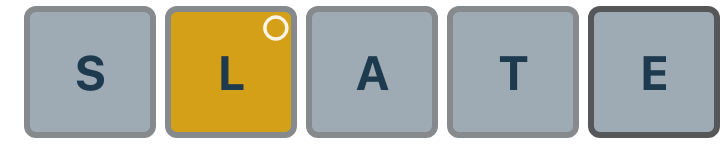
One yellow L, everything else gray. A rough start: four of your five opening letters are eliminated outright, and the one hit doesn't even tell you where. You try WOODY next, reaching for fresh, common letters:
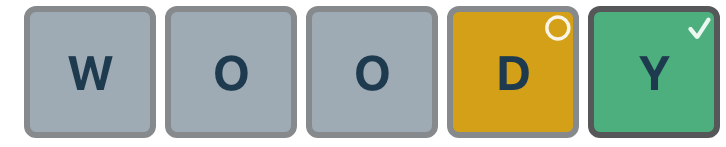
Now you've got real purchase: Y is confirmed in the last slot, and D is in the word too, just not fourth. Two guesses in, the pool has actually collapsed hard — from every five-letter word down to six real candidates: DILLY, DIMLY, DRILY, DRYLY, DULLY, DUPLY. So you try FUNNY, a common word that doesn't waste a single letter re-testing anything you already know:
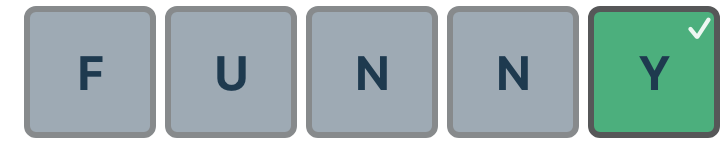
And now you're stuck. Three guesses played, and the board is telling you: last letter Y, contains L somewhere but not second, contains D somewhere but not fourth, and none of S-A-T-E-W-O-F-U-N are in the word at all. Run that shape in your head — "ends in Y, has an L and a D in it somewhere, nine common letters gone" — and it doesn't resolve into one word. It resolves into a handful of look-alikes you can half-picture and can't quite pin down.
This is exactly the moment Advanced Finder is for.
Entering what you know
Advanced Finder's grid works exactly like the Wordle board itself: type a letter into a slot, then tap the tile to cycle it through green (correct), yellow (present, wrong spot) and gray (absent). You only enter what you actually know — a position stays blank if nothing has pinned it down yet.
For this board, that's four things:
- L in the second slot, tapped to yellow — it's in the word, not there.
- D in the fourth slot, tapped to yellow — in the word, not there either.
- Y in the fifth slot, tapped to green — confirmed.
- Everything ruled out across all three guesses — S, A, T, E, W, O, F, U, N — typed into the "Letters Not in Word" box.
Positions one and three stay empty. Nothing has told you what's there yet, and the tool doesn't need you to guess.
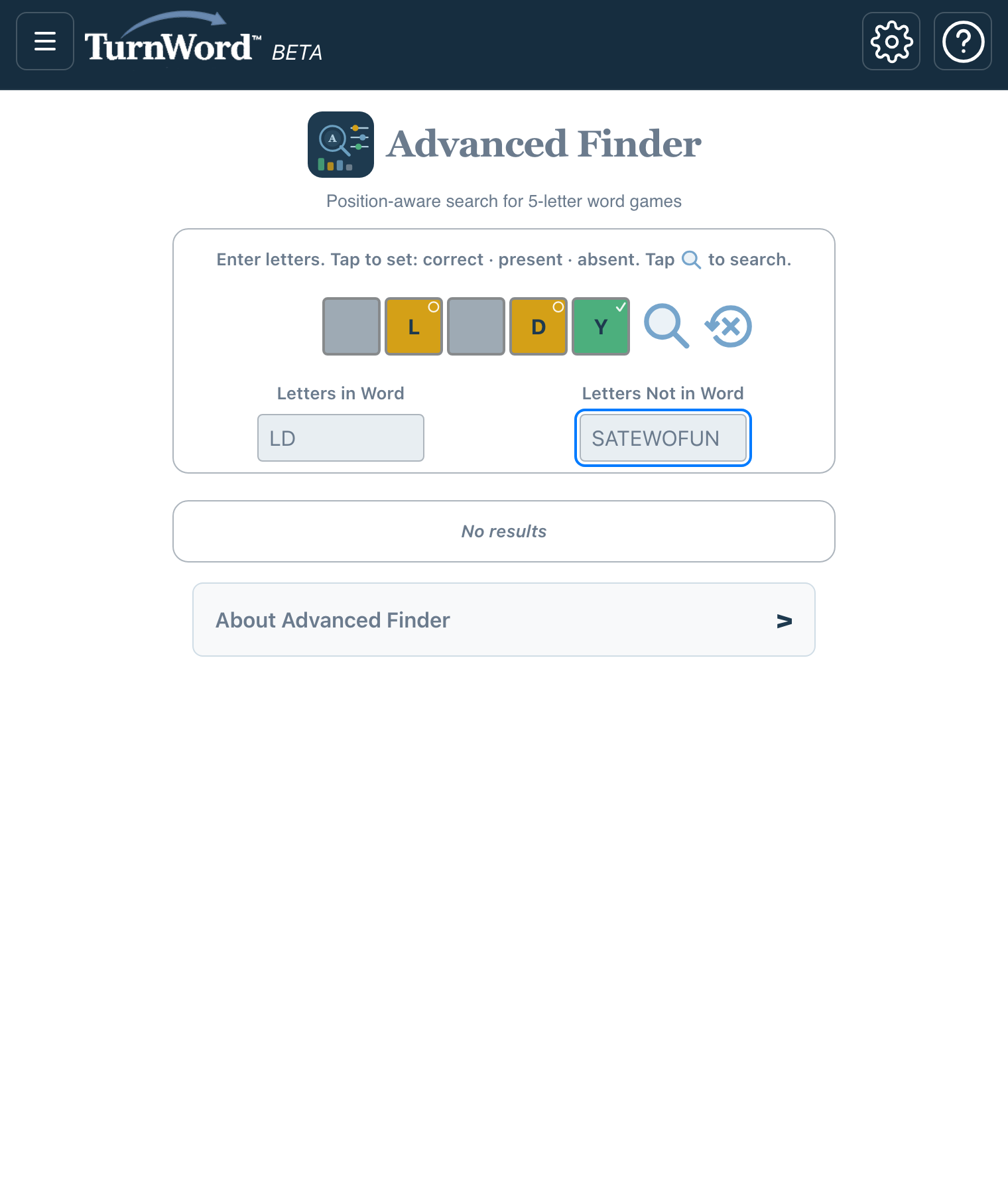
Everything three guesses actually proved, nothing assumed.
Tap Search
One tap, and the field — every five-letter word in the dictionary — collapses to exactly four:
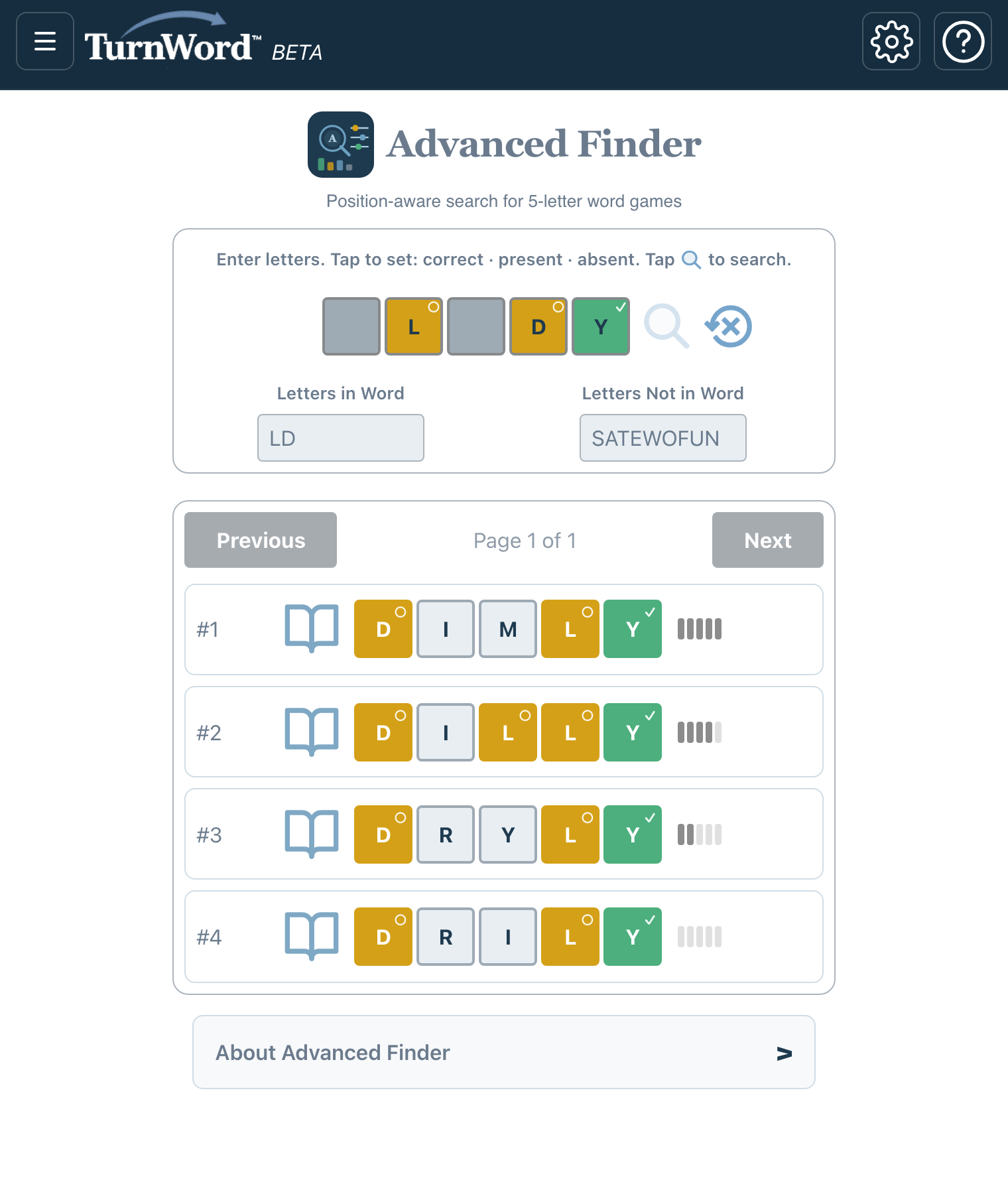
Four words. One page. No more, no less.
DIMLY, DILLY, DRYLY, DRILY — and here's the honest part: DRYLY, the actual answer, is ranked third. DIMLY and DILLY are both more common words, so they rank above it. This is the real value of the tool, and it's a narrower claim than "it finds the answer": it takes an impossible search — hundreds of plausible-looking words you can't hold in your head — and turns it into four real words you can actually see side by side. It does not read the puzzle setter's mind. It doesn't need to.
Each result is more than five letters on a list, too. Tap the book icon next to DIMLY and its definition pops up right there — "in a faint or poorly lit manner" — so you can confirm it's a real, sensible word before you commit a guess to it, without ever leaving the page:
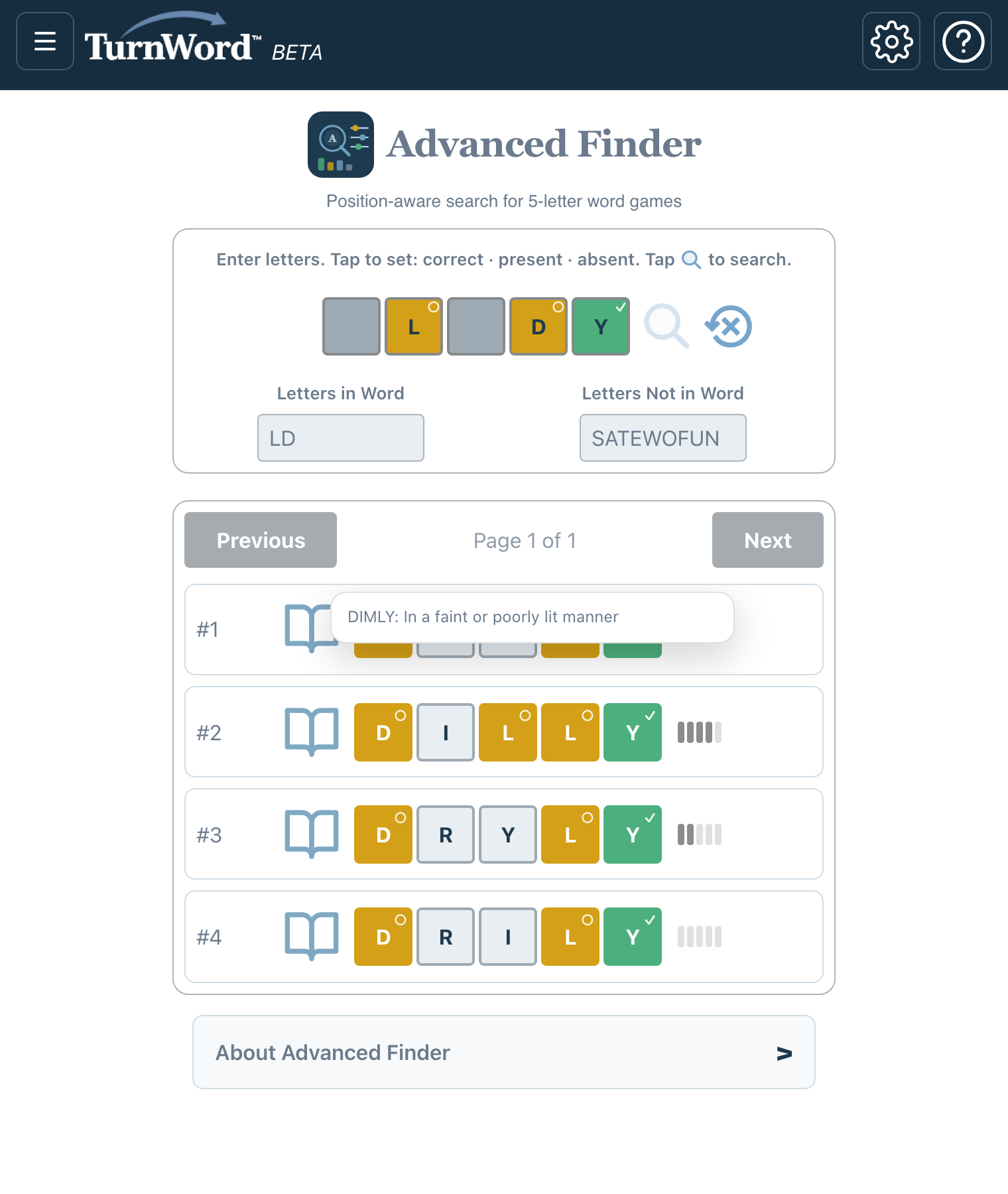
A quick reality check before you commit a guess.
Guess four, and what it actually buys you
So you play the top-ranked word, DIMLY, as guess four:
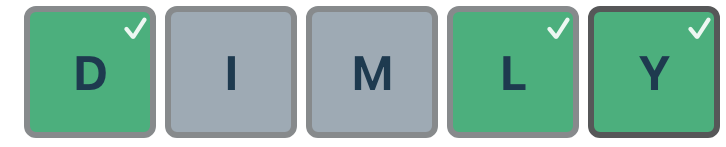
Wrong — but look at what it just did. Three letters confirmed green in one move, and I and M eliminated outright. Since DILLY and DRILY both contain an I, that single guess removes them both from the board. One candidate is left standing.
Guess five: solved
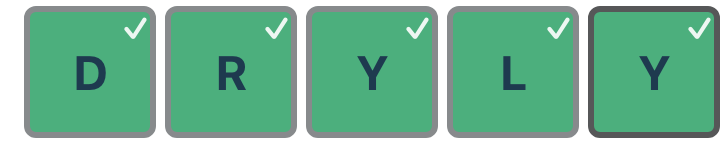
That's the real shape of this kind of puzzle. Advanced Finder doesn't hand you the word — it hands you the four words that are actually still in play, out of a field you could never have searched by hand. Guessing the most likely one isn't a loss when it's wrong: three of its five letters landed exactly right, and that alone was enough to finish the job.
The takeaway
The guess-4 wall isn't a sign you don't know enough five-letter words. It's a sign you're doing constraint-tracking in your head, which is a job better handed to a tool built for exactly that: type in the colors, and let position-aware search do the part that's actually hard — not remembering words, but remembering rules. It won't always name the answer outright. It will always get you from nothing to a short, real list, which is most of the fight.
Try it yourself
Advanced Finder is now live at TurnWord.com—free, with no account required and no ads. It joins Word Solver, Word Bot, Quick Finder, and the Wordle Archive, which lets you replay every past Wordle, including #1,909, from five standard openers. Next time you’re stuck on guess four, this is your move.