
Two Yellows, No Greens: Search by Letters, Not Positions
A real Wordle (#1,920), a 1,952-word haystack, and what a letters-only search is actually for: getting you from a two-yellow opener to a six-word cluster. Then the cluster itself — the problem no finder solves, and the one Word Solver is built for.
There's a Wordle board every player knows: your opener comes back with a yellow or two and not a single green. A couple of letters are definitely in the word, but you know nothing about where they go beyond "not there." Everything you know is about letters. None of it is about positions.
That's an awkward board for a position-based search, and a natural one for the opposite kind of tool: one that only asks which letters are in and which are out, and ranks whatever fits. That's Quick Finder. Here's the board it was built for, worked through on a real puzzle, with the numbers shown so you can check them.
How big is the haystack?
Start with what "I know there's an A and an E" actually means. TurnWord publishes 802 lists of five-letter words, generated from the same database the apps run on, each with the common puzzle answers listed first. The list for words containing A and E opens with the count: 1,952 five-letter words, of which 382 are common puzzle answers.
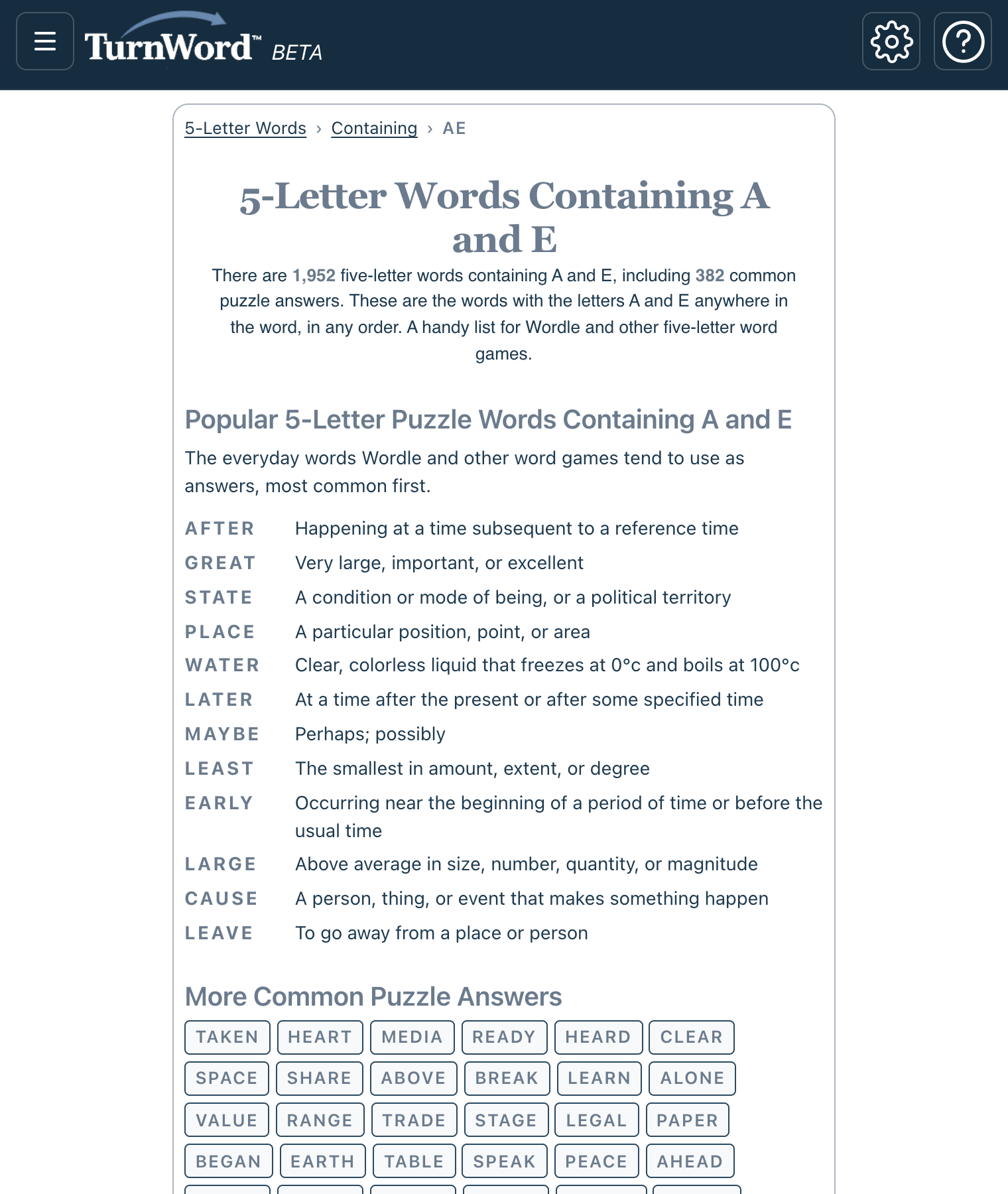
The full list, common answers first. Good for browsing; far too long to hold in your head mid-game.
Two lines from that page will matter on guess three: across those 1,952 words, "A is most often the second letter (41%)" and "E is most often the fourth letter (37%)." Know nothing else, and _A_E_ is the shape to bet on.
Quick Finder works from the same dictionary but answers a narrower question: of everything that fits your letters, which words are most likely to be the answer? Tap a letter once to mark it blue (somewhere in the word), twice to mark it gray (ruled out). It returns the 25 strongest matches ranked by everyday frequency, five to a page, each with a definition. It doesn't ask where anything goes, and it doesn't know today's answer.
The puzzle: Wordle #1,920
The answer on September 21, 2026 was PAGER — a real word almost nobody says anymore, which turns out to matter. Open with SLATE, one of the five standard openers:
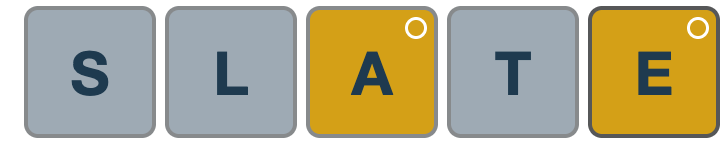
Two yellows, no greens. A and E are in; S, L and T are out; A isn't third and E isn't last. That's the whole board. Mark it in Quick Finder — A and E blue, S, L and T gray:
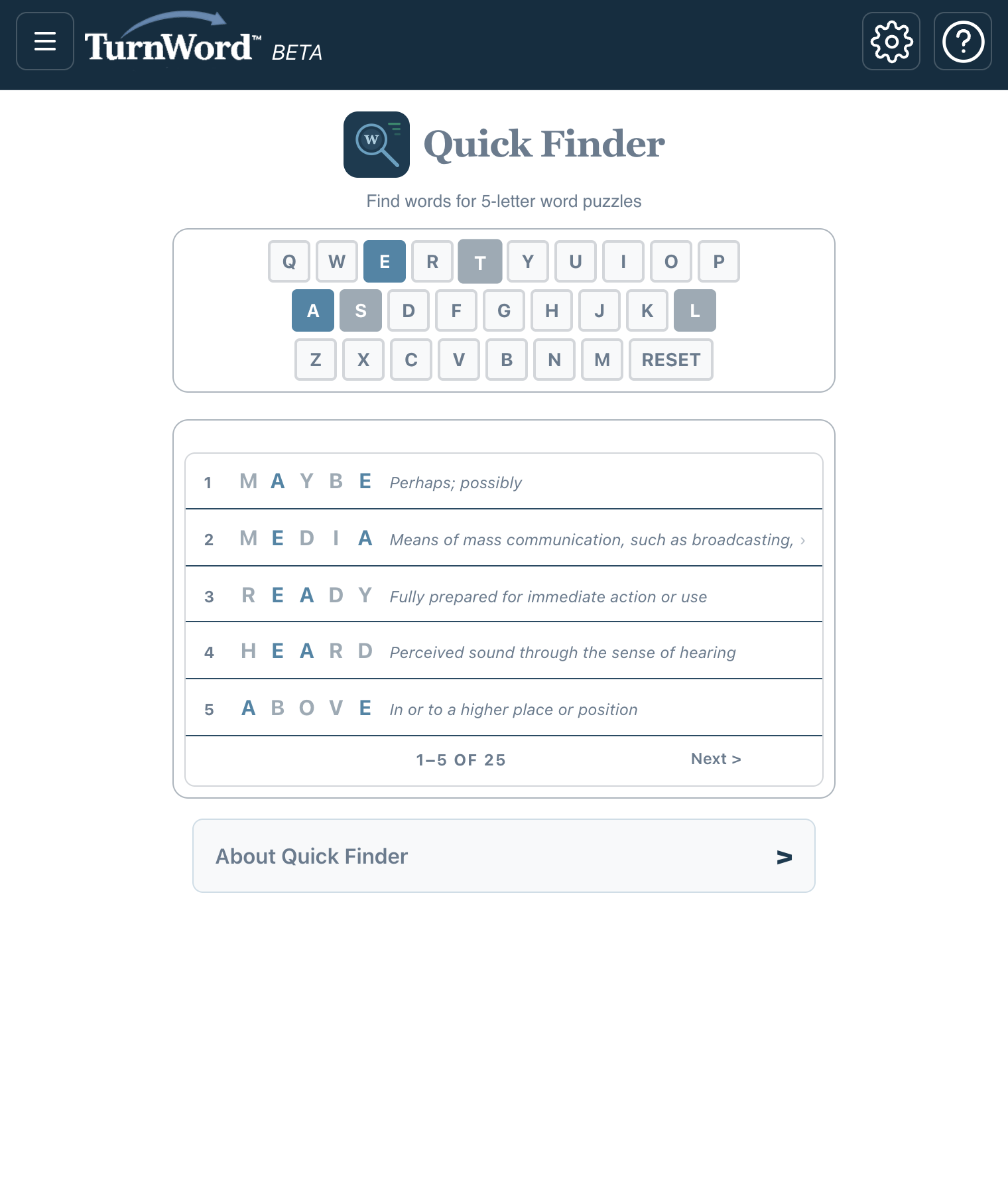
Page one of 25. Behind it, 753 words in the dictionary contain A and E and avoid S, L and T; these are the five most common.
Guess 2: read the list, then apply the board
Here's the deal you make with a letters-only tool: it doesn't know positions, so you apply them. MAYBE and ABOVE end in E, and SLATE just said E isn't last. READY and HEARD have A third, and SLATE said A isn't third. Four of the five most common words are gone before you've thought hard about anything. That's fine: the tool's job is to hand you real words to check, not to check them for you.
MEDIA survives, and it's the first word on the list that does. But it spends its three new letters on M, D and I. BREAK, first word on page two, spends them on B, R and K — and R is the most common letter you haven't tried. On TurnWord's letter-frequency table only E and A outrank it, and ER is the most common letter pair of all. Early guesses are for elimination, and R is the letter most worth settling.
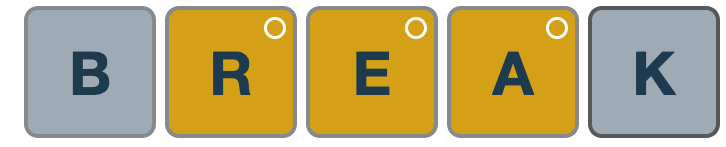
Three yellows: A, E and R are in, B and K are out, and R isn't second, E isn't third, A isn't fourth. Add R to blue, B and K to gray:
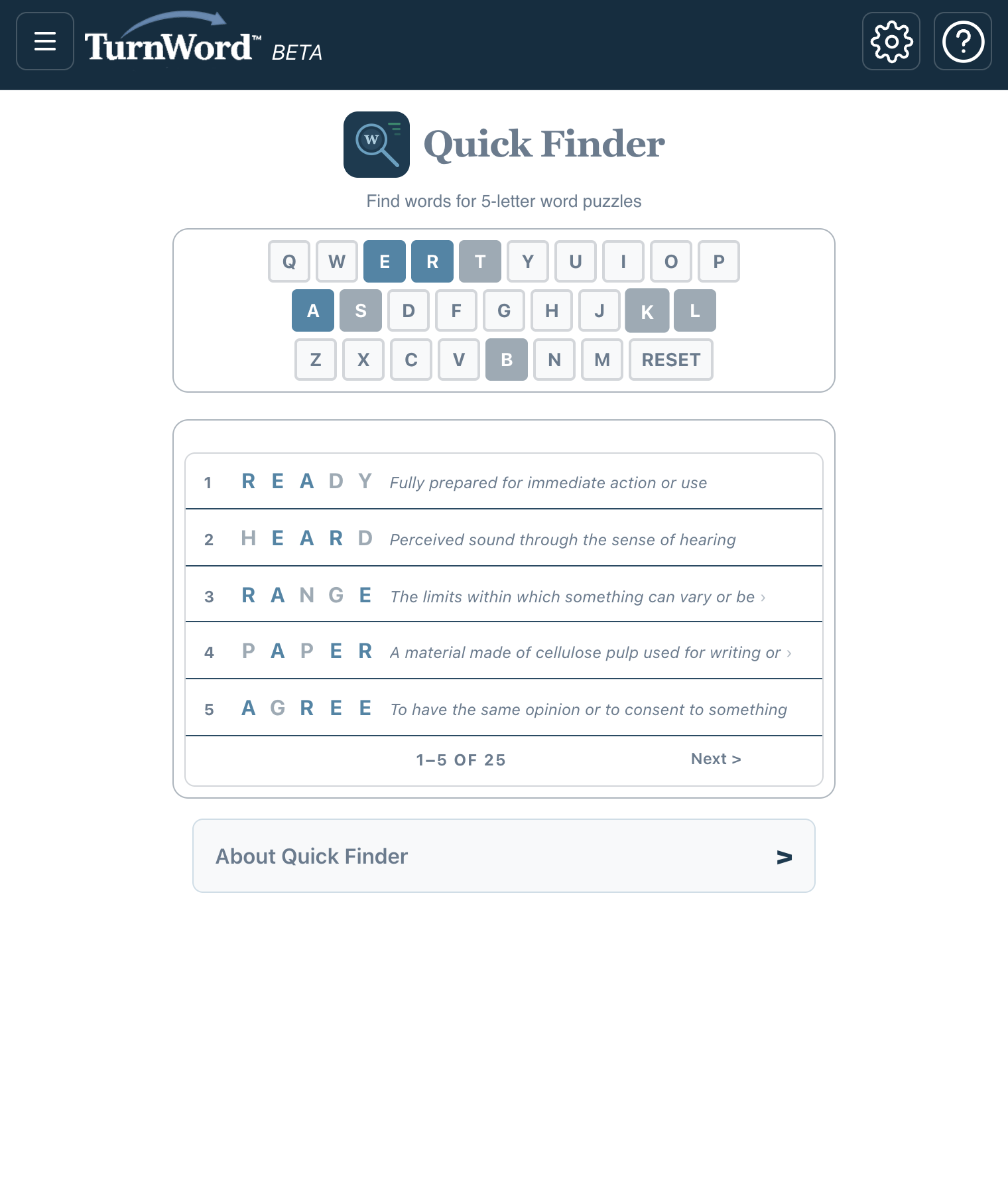
One more blue letter cut the field from 753 words to 280. Page one is nearly all words the board already rules out — except one.
Guess 3: the shape the list page predicted
Two guesses in, the board has given you five position rules: A isn't third or fourth, E isn't third or last, and R isn't second. Check page one against them. READY and HEARD put A third. RANGE ends in E. AGREE ends in E and puts R second. PAPER, fourth on the page, is the first word that passes: P-A-P-E-R puts A second, E fourth and R last, and none of those is forbidden. It's also exactly the _A_E_ shape the list page said to expect — the most common placement of an A and an E in any five-letter word that has both. Play it:
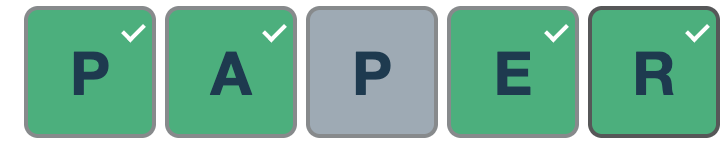
P, A, E and R all come back green: four greens on guess three. The second P comes back gray, and that gray means something precise. Wordle colors a repeated letter only as many times as it appears in the answer, so a green first P and a gray second P say there is exactly one P in the word, and it's already in the right place. The answer is P-A-?-E-R: four letters locked, one slot open.
The cluster
That open slot is where a letters-only search hits its limit, and it's worth seeing exactly how. Mark P blue as well, and Quick Finder's list is mostly noise. PAPER still ranks first — the tool doesn't know you just played it, and it can't be told "exactly one P." Then come OPERA, RAPED, GRAPE, REPAY: real words with the right letters that don't start with P. The tool can't apply the board, so you read down the list and do it yourself.
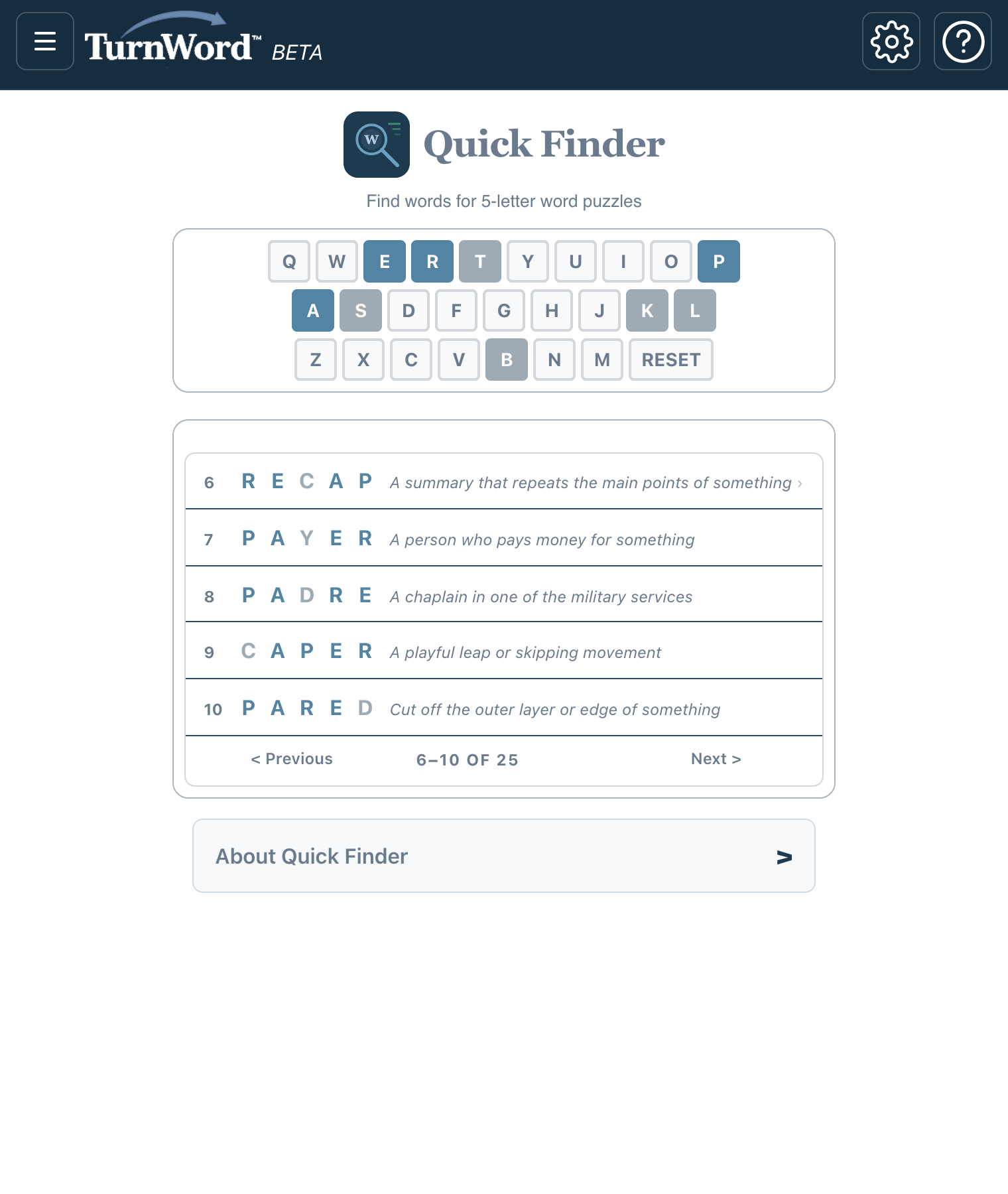
PAYER, at #7, is the first word that fits the board. PACER is #12, PAGER #14, PAVER #16, PARER #25, and PAWER doesn't make the top 25 at all.
Six words survive, and written out together the problem is obvious:
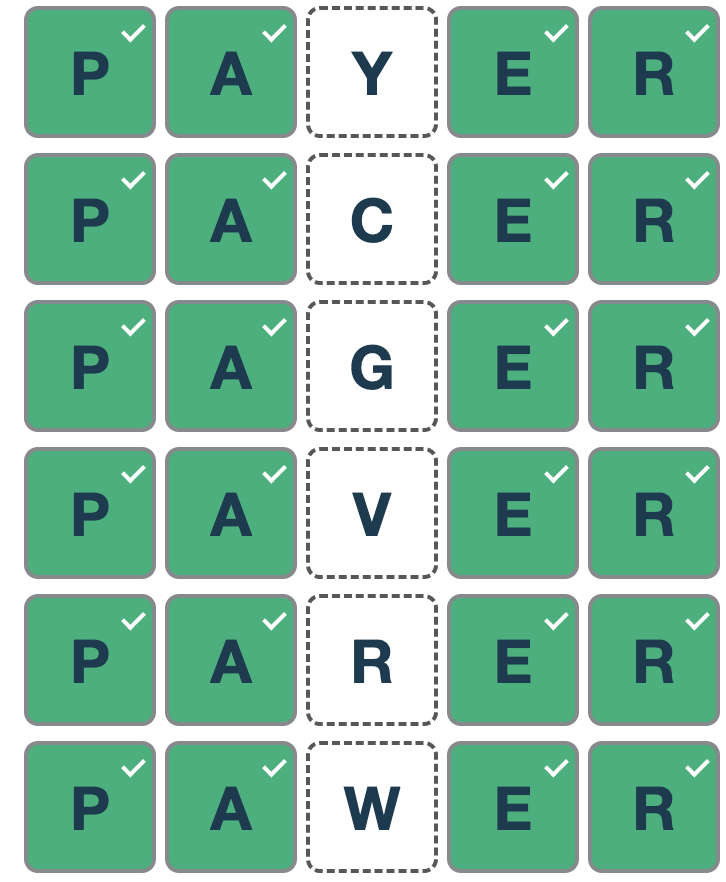
Six words, one open slot, six different letters that could fill it: Y, C, G, V, R or W.
Three guesses left, and guessing any one of these words tells you about one letter. Play them in Quick Finder's order — PAYER, PACER, PAGER — and you reach today's answer on guess six with nothing to spare. Had the answer been PAVER, PARER or PAWER, you'd have run out. TurnWord's Learn section calls this the cluster problem. It's the standard way a streak dies.
Guess 4: one guess that tests three letters
The way out is a guess that isn't trying to be the answer — a probe, played only to see which of the open-slot letters light up. You want a word packed with as many of Y, C, G, V and W as possible (R is already known to be in the word, so a probe can't test it cleanly). No real word holds four of those five; several hold three. And finding a word by the letters it contains, with no positions attached, is exactly what Quick Finder does. Tap Reset, mark C, G and Y blue, and leave everything else neutral:
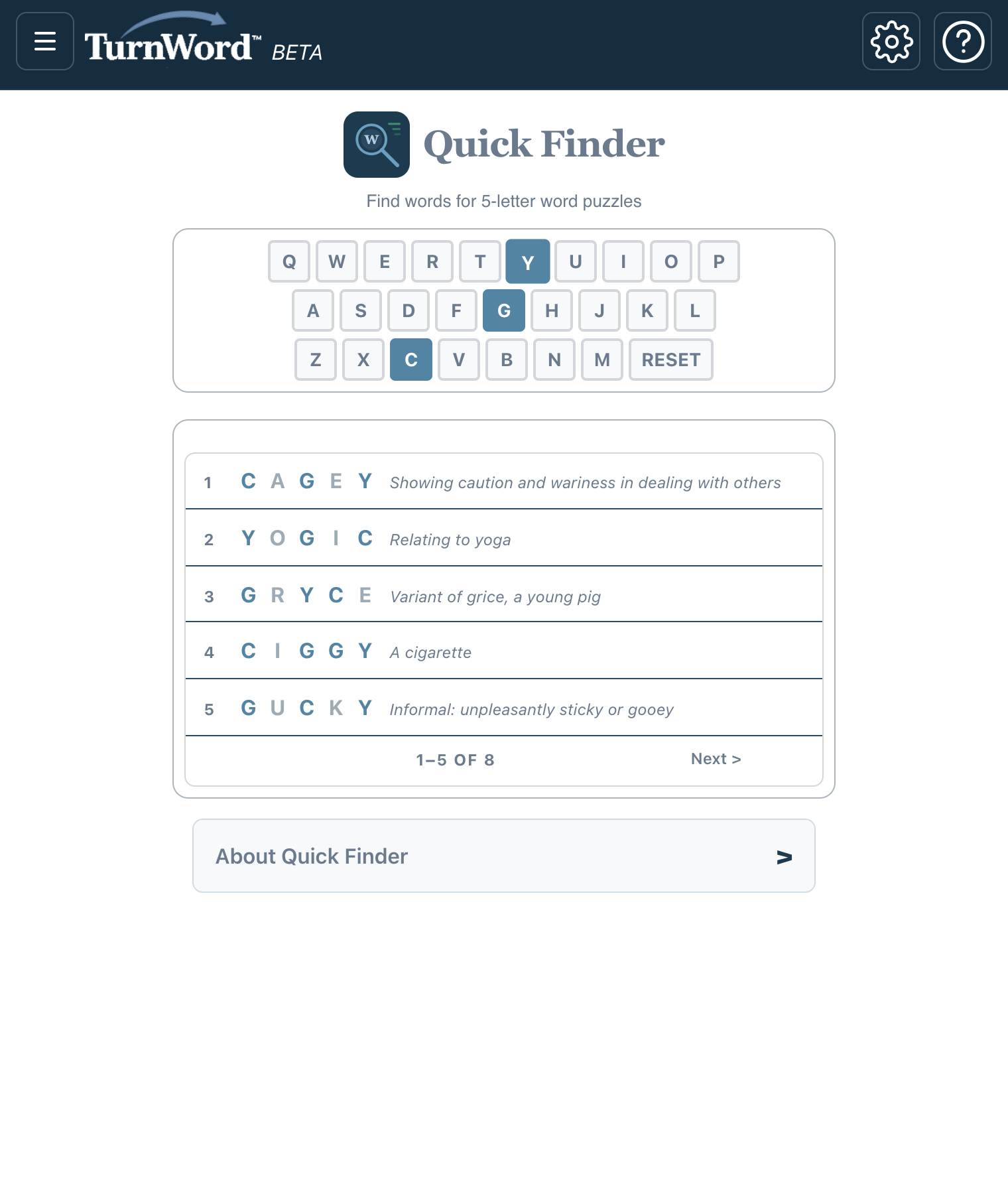
Only eight words in the dictionary contain C, G and Y. CAGEY is first, and it's a word you'd actually play.
CAGEY can't be the answer — it starts with C, and the answer starts with P. That's the point. Read its feedback for one thing only: which of C, G and Y is in the word.
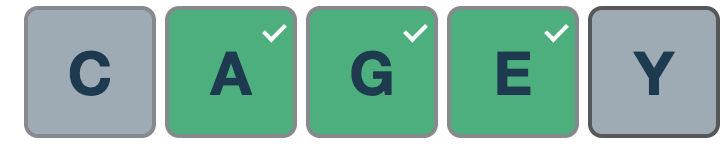
A and E come back green, which is no news. G comes back green in the open slot, and C and Y come back gray. The slot is G, and the six candidates are down to one. (A yellow C would have meant PACER; a yellow Y, PAYER. Either way, one guess settled three letters at once.)
Guess 5: solved
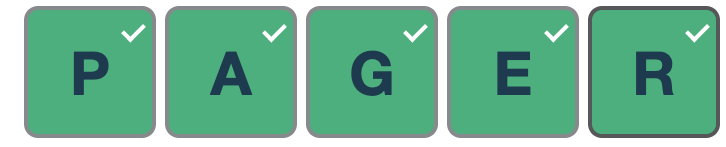
The whole game. "Has the letters" is what Quick Finder searches: words containing every blue letter and none of the gray ones. "Fits the board" adds the position rules that only you know.
| # | Guess | Feedback | Has the letters | Fits the board |
|---|---|---|---|---|
| 1 | SLATE | _ _ Y _ Y | 753 | 433 |
| 2 | BREAK | _ Y Y Y _ | 280 | 108 |
| 3 | PAPER | G G _ G G | 45 | 6 |
| 4 | CAGEY (probe) | _ G G G _ | — | 1 |
| 5 | PAGER ✓ | G G G G G |
The takeaway
A letters-only search isn't a weaker Advanced Finder. It's a different tool for a different part of the game — the part where everything you know is about which letters are in and out, and nothing yet is about where. That's most opening boards, and it's what carried this one from 753 words to six. Once you have greens, Advanced Finder shows the same field by exact position, and every 5-letter-words list opens into it with one tap.
But notice what neither finder did. Both can show you the cluster — Quick Finder by letters, Advanced Finder by position — and neither can tell you that you're in one, or what to guess next. Recognizing the cluster, deciding to spend a guess on a word that can't win, and choosing the word that tests the most letters were all on you. That isn't a search problem. It's a guess-selection problem, and it's the job of Word Solver. Hand it the same opener and it plays a different game: AMBER on guess two, which locks E and R in place; then, with every surviving word now of the form ?A?ER, it proposes PURGE on its own — marked Probe, a word it knows can't be the answer, chosen for how its feedback splits the survivors. Here that feedback pins P first and puts G in the word, and guess four is PAGER.
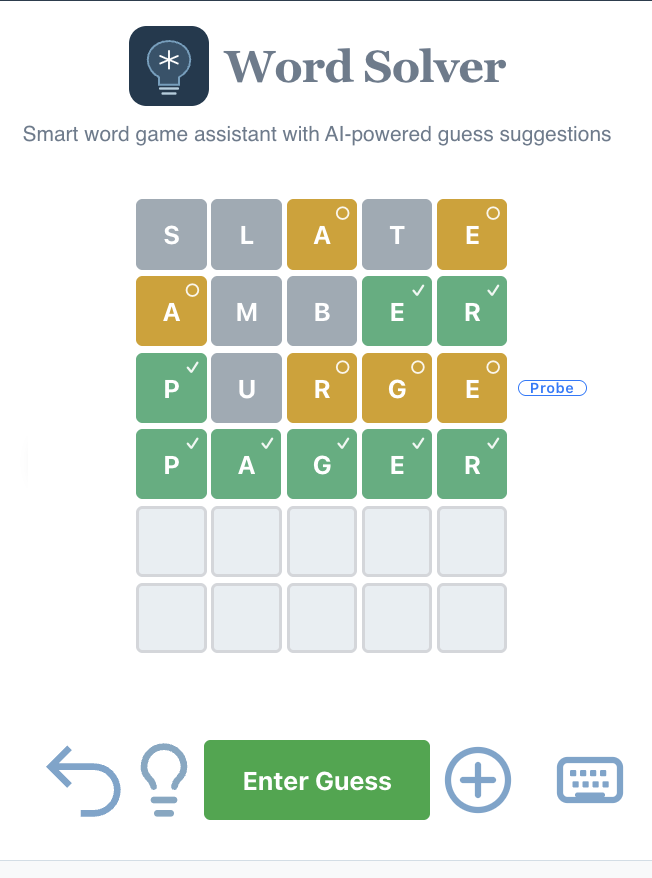
Same puzzle, same opener, one guess fewer. The probe is suggested automatically and labeled as one.
Word Solver's help page puts it plainly: when the words still in play look alike, differing in only a letter or two, and there are more of them than guesses left, trying them one at a time can run out your board — so the AI may suggest a Probe, each one testing several of those letters at once. That is exactly the board we hit on guess four, handled a guess earlier and without the detour.
So where does that leave Quick Finder? Where this piece started. It's the right tool for the two-yellow, no-green board; it gets you from an unsearchable field to a short list of real words in a couple of taps; and it will even help you build a probe by hand once you know you need one. Knowing you need one is the part Word Solver does for you. Start quick — and when the board turns into a cluster, ask the solver.
Try it yourself
Quick Finder and Word Solver are both live at turnword.com — free, no account, no ads — alongside the 5-letter-words lists, Advanced Finder, Word Bot and Word Player. Next time your opener comes back all yellow and gray, tap the letters in. And when six words differ by a single letter, let the solver take the guess.